By Jordan Grim • November 10, 2025 • 03:36 AM (PDT)

By Jordan Grim • November 10, 2025 • 03:36 AM (PDT)
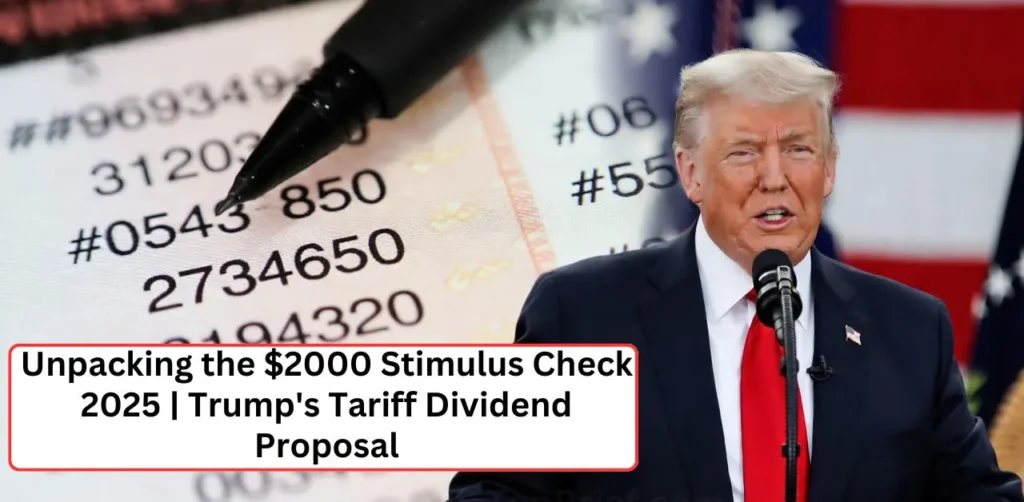
President Donald Trump has unveiled a new proposal that is drawing significant attention across the country: a plan to provide payments of at least $2,000 per person, using money raised from tariff revenues. Termed a “dividend” from the income generated by the administration’s import taxes on foreign goods, this idea has quickly become a trending topic. This potential stimulus check 2025 is distinct from previous pandemic-era payments, drawing its funding from an ongoing trade policy strategy.
The announcement was made by President Trump on his Truth Social platform early Sunday, November 9, 2025. This public musing about Americans pocketing $2000 from the tariff revenue follows a week where the White House defended the sweeping use of tariffs before the Supreme Court, where justices appeared skeptical of the broad use of the International Emergency Economic Powers Act. The announcement also came after recent elections saw Democratic victories across the country with campaigns focused on affordability and cost of living issues.
President Trump has consistently defended his use of tariffs, stating that the generated revenue would help pay down the national debt and put money directly into people’s pockets. In his Sunday post, he said the United States is bringing in trillions of dollars and will soon start reducing its massive $37 trillion debt. “He wrapped up by saying that a payout of at least $2,000 per person — excluding high-income earners — would be distributed to the public.”
The idea of a direct distribution, or dividend payment, is not entirely new. Last month, in an interview on One America News Network, Trump had floated the concept of checks worth somewhere between $1,000 and $2,000, suggesting, “We’re also considering giving Americans a direct payout — almost like a national dividend for the people.”
The actual mechanism for distributing this $2000 dividend remains to be determined. Treasury Secretary Scott Bessent, speaking on ABC News’s “This Week” on Sunday, stated he had not yet discussed the proposal with the President. Bessent noted that the $2000 dividend “could come in lots of forms, in lots of ways” that may not resemble direct stimulus checks.
He suggested that the benefit could be delivered through the President’s tax decrease agenda, mentioning potential measures like no tax on tips, no tax on overtime, no tax on Social Security, and the deductibility of auto loans. Bessent noted that these are major deductions and said they’re being covered within the tax package itself.
BREAKING: Crypto surges after President Trump announces $2,000 tariff "dividends" to be paid out to Americans.
— The Kobeissi Letter (@KobeissiLetter) November 9, 2025
Rate Cuts + Record Highs + AI + Stimulus Checks.
Buckle up. https://t.co/zIMs1lmGtB pic.twitter.com/Pu2tfHN0Nh
While the President specified that “everyone,” except for “high-income people,” would receive at least $2000, the exact income levels that would be excluded have not been detailed by the White House or the Treasury Department. It is also unclear whether children would be entitled to the same $2000 dividend.
For historical context, the two rounds of stimulus checks signed into law by President Trump during the pandemic—the $1,200 in March 2020 and the $600 in December 2020—set the full eligibility threshold for individuals making up to $75,000 a year and married couples up to $150,000. The Internal Revenue Service (IRS) previously issued over 476 million payments, totaling $814 billion in financial relief across all three pandemic rounds.
The tariffs themselves, which are taxes on foreign goods, have already generated significant revenue. Through September of this year, the government raised $195 billion in revenue from these tariffs. This marks a 250 percent increase compared with the amount collected in the previous fiscal year (2024), representing an additional $118 billion. The Treasury Department projects that the tariffs are expected to generate roughly $3 trillion over the next decade.
Despite the revenue, Treasury Secretary Bessent emphasized that the primary goal of the tariffs is not revenue generation but rather to address unfair trade imbalances. He pointed out that the tariff revenue is only part of the early process, saying, “This isn’t about collecting money — it’s about resetting the balance. The revenue comes in at the beginning, and as things even out and more jobs return to the U.S., it eventually turns into domestic tax income.”
The promise of a $2000 stimulus check 2025 is also fueling speculation in the cryptocurrency market. The prospect of the government sending out direct payments has historically preceded an uptrend in the price of Bitcoin, similar to the boom seen after the COVID-era stimulus checks were issued. One analysis noted that the last time a similar payment was issued, it helped start the 2021 crypto bull run. The overall U.S. national debt is a major point of discussion, having surged to almost $38 trillion this year.